Why CI/CD Matters in Legacy Modernization
Legacy systems commonly hold businesses back. Long release cycles, fragile deployment processes, and limited visibility into system health increase business risk and operational costs.
If your modernization program still depends on manual human intervention - hand-built releases, “hero” deployments, or irregular code releases - you don’t just move slower. You increase failure risk, inflate operational burden on operations teams, and make customer-facing change harder to control.
For decision makers, CI/CD DevOps is not a tooling debate. It’s a governance and execution model for modernization:
- Accelerates software delivery without trading off software quality;
- Reduces downtime through a repeatable deployment process and production deployment controls;
- Creates traceability (auditability) across the software development lifecycle;
- Enables faster stakeholder feedback loops so the final product aligns with user expectations;
Industry sources describe a CI/CD pipeline as an automated process that improves software delivery across the software development life cycle via automation.
Understanding CI/CD and DevOps in Context
What Is CI/CD in DevOps?
CI/CD represents engineering practices and automated processes that make code integration, verification, and delivery repeatable and low-risk - especially critical when modernizing existing code.
- Continuous integration means frequently merging code and integrating code into a shared source code repository, then validating code changes through an automated build, unit tests, and running automated tests (often plus integration tests).
- Continuous delivery keeps tested code in a deployable state so it can be released to any testing or production environment on business demand.
- Continuous deployment extends that model by automatically deploying code to the production environment after gates pass - removing manual release steps where appropriate.
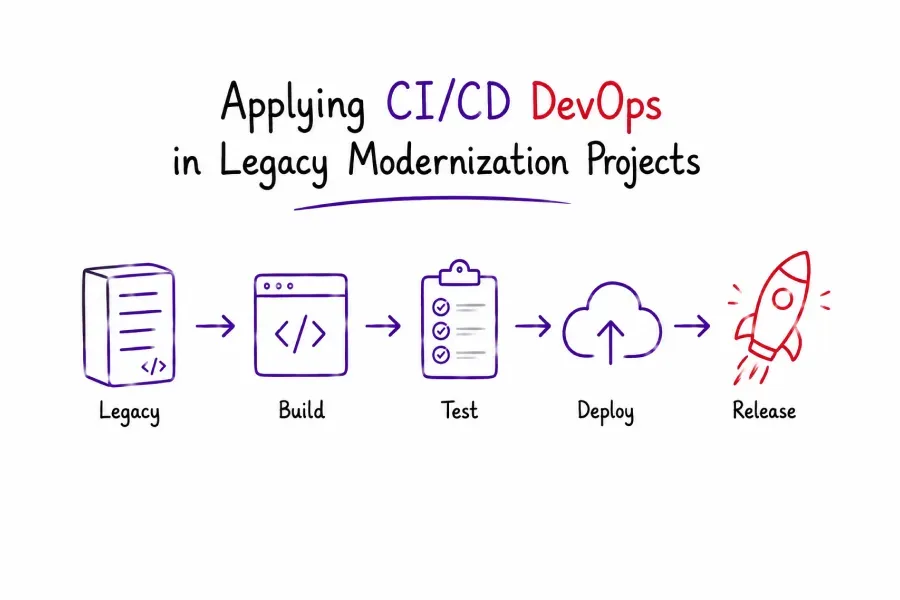
Put simply: CI/CD automates the software development process, from coding through deployment, so your product can respond to user needs faster - without chaos.
DevOps is the cultural and organizational layer: it aligns development and operations teams (plus QA/security) around shared ownership, reliability, and delivery outcomes. CI/CD is the execution engine that turns that collaboration into a controlled, repeatable software delivery system.
A practical reality for leaders: adopting DevOps and CI/CD often produces longer pipelines and toolchains, increasing developer responsibility for delivery and operational outcomes - so platform engineering, enablement, and guardrails matter.
The Benefits of CI/CD for Modernization Projects
When properly implemented, CI/CD is a modernization force multiplier - because it reduces risk while increasing throughput.
Faster delivery with measurable controls
DORA highlights four core metrics used to measure software delivery performance - deployment frequency, lead time for changes, change failure rate, and time to restore service (MTTR).
For decision makers, these are the scoreboard: you can track whether modernization is truly improving delivery speed and operational resilience.
Lower downtime, faster recovery
CI/CD makes it easier to fix issues and recover from incidents because deployments are smaller, repeatable, and support rollback strategies - reducing MTTR when something goes wrong. (That’s why MTTR is explicitly baked into DORA-style measurement.)
Higher quality, fewer production surprises
CI/CD reduces downtime and improves software quality by automating verification - automated testing, continuous testing, regression testing, and (when done right) static code analysis inside the CI/CD pipeline.
Better stakeholder alignment (less “building the wrong thing”)
Integrating CI/CD into workflows enables quicker feedback loops with stakeholders - so what ships aligns more closely with user expectations. Atlassian explicitly notes that combining delivery metrics with customer feedback helps teams focus improvements where they matter.
Establishing continuous feedback loops isn’t “nice to have.” It’s how you improve CI/CD processes and sustain high-quality software delivery.
Developer productivity + sustainability
By automating repetitive release work, CI/CD can free up developer time and reduce deployment pain. For modernization programs, that translates into higher developer productivity, fewer bottlenecks, and less burnout risk over time - especially when multiple developers are continuously integrating safely instead of waiting on a fragile release window.
Implementing CI/CD in Legacy Environments
Challenges of Adopting CI/CD for Legacy Systems
Monolithic architectures and code entanglement
Tight coupling creates integration issues: one change ripples everywhere. That makes isolated testing and independent deployment hard. You typically need incremental refactoring plus regression testing as a safety net, and a staged approach to disentangling components.
Lack of test automation and documentation
Legacy estates often lack reliable unit tests and integration tests, which can cause slow confidence-building. CI/CD can require upfront investment in further automated testing to avoid “green builds that lie” (or flaky tests that block releases and erode trust).
Infrastructure limitations and resistance to change
Old deployment scripts, brittle environments, and manual infrastructure steps block repeatability. This is exactly why Infrastructure as Code (IaC) matters: it ensures consistency across development, staging environment, and production environments via versioned infrastructure management and consistent infrastructure provisioning.
Leaders should treat these constraints as program risks - not engineering inconveniences - because they directly affect timelines, cost, and reliability.
Modernizing Incrementally: DevOps Patterns for Legacy
Strangling the monolith: modularizing and containerizing legacy apps
The highest-risk move is the full rewrite. A decision-grade modernization strategy uses incremental patterns to reduce blast radius:
- Extract one bounded capability at a time from the monolith (strangler pattern);
- Introduce clear APIs and deployment boundaries;
- Containerize where it makes sense to standardize runtime behavior across development environments and production;
Container platforms (Docker) and orchestration (Kubernetes) help eliminate environment drift and streamline repeatable deployment.
Setting up CI pipelines even with older codebases
Start with the minimum viable CI/CD:
- Put everything under version control (and enforce one version control system workflow).
- Add a CI stage that builds every commit to the mainline (main branch) and runs running tests (at least smoke + core unit tests).
- Expand to integration tests and environment promotion stages across dev → staging environment → production.
Two decision-maker details that matter here:
- Map pipeline stages and define roles across teams to reduce handoffs and bottlenecks (development, QA, security, operations). This aligns DevOps practices with CI/CD flow and reduces “it’s not my job” failure modes.
- Keep pipeline definitions as code so the delivery system is versioned like the product.
Using feature flags, blue/green deployments, and canary releases
These patterns separate deployment from feature exposure - so you can keep deploying code safely while controlling risk:
- Feature flags: ship code, keep new features hidden until validated.
- Blue/green: swap traffic between two identical environments.
- Canary releases: shift traffic gradually and monitor signals.
This is how you reduce deployment failures while still letting code releases happen faster.
Key Tools and Technologies for CI/CD Modernization
For decision makers, tooling choices should serve three outcomes: repeatability, security, and scale.
CI/CD platforms (DevOps tools)
The major public cloud providers offer CI/CD solutions, and so do vendors like GitLab, CircleCI, Travis CI, and Atlassian Bamboo.
- GitLab positions itself as a single application for the entire DevSecOps lifecycle - covering CI/CD fundamentals in one environment.
- Red Hat defines CI/CD pipelines as established steps developers follow to deliver new versions of software, emphasizing automation across the lifecycle.
Kubernetes-native pipelines
Tekton is a cloud-native CI/CD framework designed for Kubernetes-based execution models.
Infrastructure as Code (IaC)
IaC ensures consistency across dev/staging/prod and supports repeatable automate infrastructure provisioning - a prerequisite for reliable continuous delivery in legacy modernization.
Security and quality gates
Embed static code analysis, dependency scanning, and policy checks into the automated system builds so quality and security move at the same speed as delivery.
Monitoring tools
Monitoring and observability close the loop - so you can prove reliability in production, detect regressions, and drive continuous improvement.
Security, Compliance & Governance in Legacy CI/CD
Integrating DevSecOps into CI/CD Pipelines
A key component of DevOps is introducing a secure CI/CD pipeline where security is a shared responsibility across the IT lifecycle.
Automate security checks early and often: Run static analysis and dependency checks as part of CI - before merging to the main branch - so defects are caught when they’re cheapest to fix.
Protect secrets and credentials: No credentials in repositories. Use vaults, least-privilege CI agents, rotation, and auditable access.
Scan dependencies continuously: Block promotion when a test fails due to vulnerabilities - so risky code can’t advance into a testing or production environment.
(For decision makers: this is not “extra process.” It’s how you avoid modernization, creating new security debt.)
Governance for Regulated Industries
Modernization in finance, healthcare, or government must satisfy compliance without slowing delivery to a crawl.
Audit trails and compliance checkpoints in CI/CD
Use immutable logs, signed artifacts, and approval gates to create traceable evidence of who approved what and why - within the collaborative framework of your pipeline runs.
Ensuring HIPAA, FERPA, or NIST compliance during legacy transitions
Map regulatory controls to pipeline stages. Where human review is required, embed it with evidence collection so audits become predictable rather than disruptive.
Risk mitigation through automated testing and rollback strategies
Use automated health checks, progressive delivery (canary), and rollback triggers so you can contain incidents quickly. This is the operational safety net that lets modernization continue without unacceptable business risk.
CI/CD as the Backbone of Legacy System Transformation
For decision makers, CI/CD is the backbone because it turns modernization from a “big bang project” into a controlled, measurable software development practice:
- It automates the software development cycle end-to-end (build → test → release → deploy)
- It reduces manual intervention and deployment pain
- It improves code quality through automated testing, integration tests, and continuous testing
- It enables faster recovery (lower MTTR) and higher customer satisfaction through fewer production defects
Final Thoughts
Red Hat describes CI/CD pipelines as a practice focused on improving software delivery throughout the software development life cycle via automation.
And DORA-style metrics give you a clear way to quantify whether your modernization program is improving outcomes (lead time, deployment frequency, failure rate, restore time).
One forward-looking note for 2025 planning: modern pipelines increasingly incorporate AI/ML techniques for predictive analytics, failure prediction, and smarter automation - often framed under AIOps and intelligent automation - aimed at reducing downtime and speeding troubleshooting.
Bottom line: if your legacy modernization program doesn’t treat CI/CD, DevOps culture, and platform engineering as first-class program components, you’re likely to modernize slower, spend more, and carry more risk. If you do treat them as first-class, you get a modernization engine where code changes flow reliably from commit to production - with governance, traceability, and measurable outcomes.