
Build Intelligent AI Agents with Context Engineering
Transform your AI from reactive to proactive. Create context-aware AI agents that understand user intent, remember interactions, and deliver personalized experiences at enterprise scale.
Time Savings
Productivity Gain
Workdays Saved
Time Savings
Productivity Gain
Workdays Saved
Why 73% of AI Agent Projects Fail to Deliver Value
Traditional AI assistants and RAG systems lack the context awareness needed for intelligent decision-making. The result? Frustrated users, wasted investment, and AI that can't scale.
Lost Context
❌ Your AI agents forget what users just told them
❌ Conversations feel repetitive and frustrating
❌ Accuracy drops to 60% in multi-turn interactions
Impact: 40% of queries need clarification, 35% user satisfaction
No Memory Management
❌ Each session starts from zero
❌ Can't leverage user history or preferences
❌ Personalization is impossible at scale
Impact: Generic responses, low engagement, high churn
Broken Orchestration
❌ AI agents can't coordinate across systems
❌ Multi-agent workflows fail under complexity
❌ Integration becomes a maintenance nightmare
Impact: 6-month implementation times, $2.4M average waste
No Real Intelligence
❌ Native retrieval augmented generation (RAG)
❌ Can't adapt to changing situations
❌ No true human-AI collaboration
Impact: AI that can't scale, constant manual intervention needed
The problem isn't your AI models, it's the lack of context.
Let's work together to give your AI the real-world understanding it needs to succeed.
Context Engineering - The Missing Layer for Intelligent AI Systems
Go beyond basic RAG and AI assistants. Build AI agents that truly understand your business through advanced context management and human AI collaboration.

How it works
We make building intelligent, context-aware applications simple. Our four-step process ensures your AI systems get the real-world understanding they need to be truly effective.
Context Modeling
Design unified context models that integrate information from multiple sources: user behavior, session data, temporal factors, environment, and domain knowledge.
Result: AI that understands the complete picture
Context Orchestration
Build intelligent AI orchestration systems with agent orchestration that ensure your AI agents always have access to the right context at the right time through intelligent memory management.
Result: Relevant information, every time
Context-Aware Applications
Deploy AI-powered applications and smarter apps that are truly context-aware AI solutions. They anticipate user needs, adapt to situations, and deliver personalized experiences through human AI collaboration.
Result: AI that feels like it knows your business
Our Proven Context Engineering Methodology
DISCOVER & DESIGN
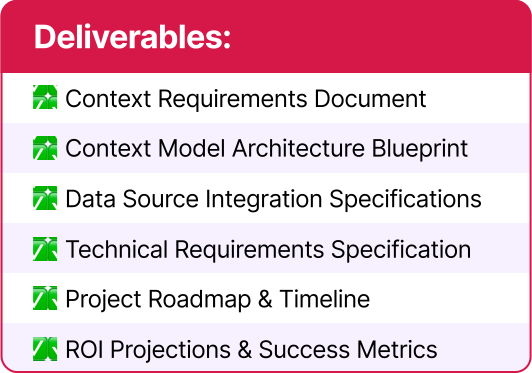
- Context Requirements Analysis
Deep-dive workshops to understand your business goals, current AI limitations, and ideal outcomes. We map your existing workflows, data sources, and integration requirements.
- AI Agent Architecture Design
We design optimal ai agent architectures, including system prompts, prompt architecture, and system instructions that align with your use cases.
- Context Model Blueprint
Create comprehensive context management strategy that defines what information your intelligent AI needs to be truly context-aware.
- Success Metrics Definition
Establish clear KPIs and success criteria so we can measure impact from day one.
AI Agents, Built for Production
Built on Industry-Leading AI Technologies

AI Models & Frameworks
- GPT, Gemini
- Custom fine-tuned models
- Open-source LLMs (Llama, Mistral)
- Hybrid model orchestration

RAG & Context Engineering
- LangChain, LlamaIndex
- Custom context orchestration engines
- Vector databases: Pinecone, Weaviate, Chroma
- Semantic search optimization

Cloud & Infrastructure
- AWS Bedrock, Azure OpenAI
- Google Vertex AI
- Multi-cloud deployments
- Edge computing for latency-sensitive apps

Development & Integration
- Python, TypeScript/Node.js
- RESTful & GraphQL APIs
- Webhook integrations
- Real-time data pipelines

Specializations
- Agentic AI architectures
- Multi-agent collaboration systems
- Memory management & context persistence
- Prompt engineering & optimization
Success Stories
€40,000 Saved Annually: Custom HR Tool Replaced Costly Solutions
We analyzed the context of our HR operations and found high licensing fees, limited flexibility, and fragmented workflows. By understanding these core pain points, we developed a single, custom-built tool that aligned with internal processes, eliminated €40,000 in annual costs, and provided a secure, scalable solution.

90% Faster Reporting, 83% Fewer Missed Meetings: HR Transformed in One Week
We analyzed the context of our HR process, identifying fragmented data across Excel and manual reporting as key blockers to leadership insights. By understanding this, we built a custom platform to centralize 1-on-1 data, automate reporting, and track feedback, resulting in 90% faster reporting and an 83% decrease in missed meetings.

Book a Free Consultation
Trusted by leading businesses worldwide



Book a Free Consultation
Everything you need to know before building context-aware AI agents.
Before You Start
Your AI is only as smart as what it remembers and understands in the moment.
Context engineering is the layer that decides what your AI knows when it answers: who the user is, what they said two turns ago, your business rules, what the situation calls for. A model without it answers every question from a blank slate. With it, the AI works from the full picture instead of guessing.
Retrieval finds documents. It doesn't give your AI memory, judgment, or the ability to act.
RAG pulls relevant text into a prompt, which helps with single questions. It doesn't carry state across a conversation, learn a user's history, or coordinate steps. That's why a system that demos well starts repeating itself and asking for clarification the moment real users push on it. Context engineering is the part RAG leaves out.
An assistant answers. An agent remembers, decides, and gets something done.
An assistant responds to one prompt at a time and forgets the rest. An agent holds context across the whole interaction, draws on history and your systems, and carries a task to completion. The difference shows up in multi-step work, where assistants stall and agents keep going.
Demos are single-turn. Production is messy, multi-turn, and full of edge cases.
A scripted demo never tests what happens on the fifth turn, when the AI has lost track of the conversation, or when two users want different things from the same system. Accuracy drops, answers turn generic, and people stop trusting it. The model usually isn't the problem. The missing context is.
Technical Details
Memory is engineered, not assumed.
We build a managed memory layer that decides what to keep, what to retrieve, and what to forget: conversation state, user preferences, and the history that makes the next answer better than the last. Each session builds on the one before instead of starting from zero.
By default, generic AI vendors want your data in their cloud, training their models. We build the opposite.
We run your AI on infrastructure you control, on-premise where you need it. Your context, your documents, and your customer data stay yours. GDPR-native, NIS2-ready, no leakage into ecosystems you never agreed to. We've worked with patient and transactional data for over a decade, the most regulated data in the EU.
One agent is easy. Getting several to work together without falling over is the hard part.
We design the orchestration so agents share context, hand off cleanly, and pull from the right source at the right time. We integrate with the systems you already run through APIs and real-time pipelines, so the AI works inside your business instead of beside it.
The right stack is the one that fits your problem and that you can still run after we leave.
We decide after Discovery. We work across commercial models like GPT and Gemini, open-source models like Llama and Mistral, frameworks like LangChain and LlamaIndex, and vector databases like Pinecone, Weaviate, and Chroma. When ownership matters, we fine-tune and host models you control. No vendor lock-in.
Process, Cost & Risk
The most expensive AI mistakes happen before anyone writes a prompt.
For a short, fixed-price phase, we map your use case, your data sources, your integration points, and what the AI actually needs to know to be useful. You leave with a clear architecture, defined success metrics, and a realistic plan, whether or not you continue with us.
We set the targets on day one, in numbers you care about.
Before building, we agree on KPIs tied to your goals: accuracy on multi-turn tasks, time saved, queries resolved without a human, adoption. We measure against them from the first release so you see impact, not a vague promise of intelligence.
You pay when working software ships, not when hours pile up.
After Discovery, you get a phased plan with a fixed cost per milestone. Our invoices say "delivered," not "hours worked." You see exactly what you pay for and exactly what you get at each stage.
Weeks to a working agent, not a six-month implementation.
We deliver in phases, so you get a usable system early and improve it from there instead of waiting half a year for a single launch. The total depends on how many systems you integrate and how complex your context is, and we give you a real range after Discovery.
An AI system that ships and then drifts is a liability.
We monitor performance, watch for accuracy drift as your data and usage change, and keep tuning the context and the models. You get a team that stays with the system, not a handover and a goodbye.
Why Intertec
Hiring AI engineers is slow. Generic vendors solve their lock-in, not your problem.
Experienced AI engineers take months to find and align in the DACH region, and a generic platform wants your data in its cloud and your roadmap on its terms. We bring a team that has built context-aware systems before, working on your infrastructure, with your data staying yours.
Five things, and they're the five things most AI vendors can't put on their own website.
You pay on delivery. Milestones, not hours. Discovery comes first, so we solve the real problem, not the one you assumed. The team stays, under 5% turnover on long engagements, so the engineer who designs your system is the one running it. Your data stays yours, on your infrastructure, GDPR-native and NIS2-ready. And AI is our business, so you stay focused on yours.
Getting Started
Thirty minutes. No pitch, no slides.
You tell us where your AI falls short and what you want it to do. You ask us anything. By the end, we both know whether context engineering fits your problem, and if it does, Discovery is the next step.
A real use case and an honest description of where your current AI breaks.
No formal documentation. If you can describe what you want the AI to do, who uses it, and where it falls short today, that's plenty for a productive first call.