
Data Engineering Services for Modern Data-Driven Organizations
From data platform modernization to building real-time pipelines, we design custom data infrastructure that fuels decisions, growth, and resilience. Not sure where to begin? Get a free Data Assessment Quick Check.
Free Data Assessment Data Assessment Quick Check

How We Help You Unlock your Data Potential
We eliminate silos and simplify your architecture - turning scattered data into actionable intelligence, fast.
Foster a Data-Driven Culture
Make data part of your company’s DNA. We help you build data literacy, guide internal adoption, and drive real organizational change through smart communication and leadership alignment.
Define Your Data Strategy
From vision to roadmap, we help you identify high-impact use cases, set governance standards, and lay the foundation for modern data engineering best practices inside your organization.
Build the Right Data Skills
Bridge the gap between tools and talent. Our data engineering consulting equips your workforce with the right capabilities through skill profiling, pair programming, and targeted enablement workshops.
Scale with a Cloud Data Platform
We bring cloud data engineering to life - using proven frameworks and accelerators to help you deploy, scale, and extract value from your data infrastructure faster than ever.
All Your Data in One Place
A single, modern data engineering platform that brings everything together - faster, smarter, and built for better decisions.

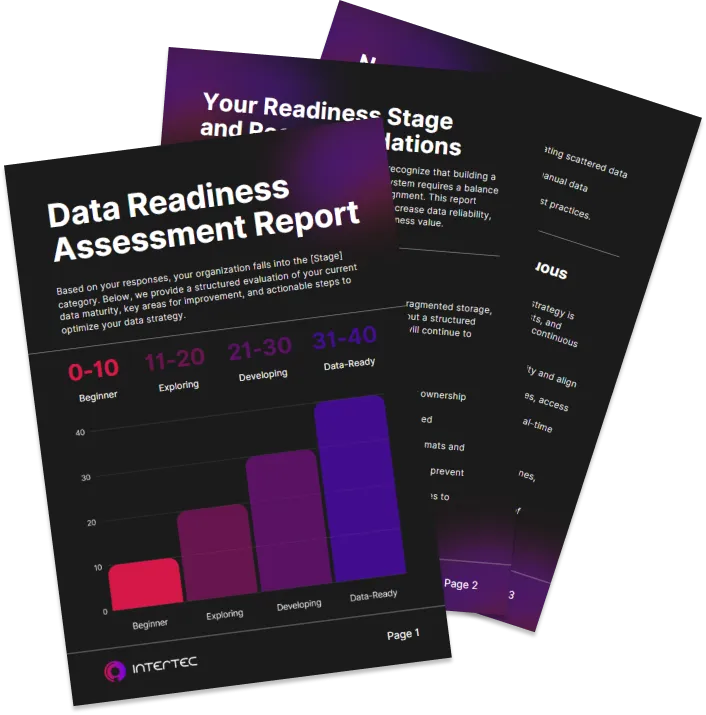
Unlock Your Data's Potential in Just 3 Minutes!
- Instant Digital Maturity Score;
- Clear roadmap to break down data silos & improve efficiency;
- Benchmark your strategy against industry leaders;
Your competitors are already leveraging big data engineering. Are you?
Proven Use Cases
Meraxis Digital Supply Chain Transform Delivers 75% Revenue Growth
A global polymer leader struggled with inefficient order management and fragmented information across disconnected systems. We implemented a scalable Data Engineering solution with B2B portals and automated analytics, resulting in 75% of revenue being generated through digital channels and a 40% increase in business value.

LabV Achieved 90% Faster Reports with Data Transformation
LabV, specializing in software for managing testing lab data, struggled with disconnected data storage, project inefficiencies, and limited custom reporting. Intertec developed a platform to unify data from diverse devices, resulting in 90% faster report generation and a 50% reduction in data processing time.

Data Engineering Services
From extraction to integration, we streamline every step for clean, connected, and insight-ready data - ready for action with scalable data engineering services.
Technology Stack

Kafka

Scala

Python

Grafana

Azure DataBricks

AWS

PostgreSQL

MySQL

Apache Spark
Want quick insights? Take the 3-minute Data Assessment.
Becoming a data-driven organization starts with knowing where you stand. This quick check assesses your data maturity, identifies gaps, and maps out your next step toward a modern data engineering strategy.
Frequently asked questions
Before You Start
Most companies don't have a data problem. They have a “data scattered across twelve systems that don't agree with each other” problem.
We build the pipelines and platforms that pull your data out of those silos, clean it, and put it in one place your teams can actually use, whether that's a warehouse, a lake, or a real-time stream. The goal isn't a prettier dashboard. It's that the number your CFO sees and the number your operations lead sees finally match, and both arrive without someone exporting spreadsheets at midnight.
“We can get the report eventually” is quietly expensive.
A reporting process that ties up three people for two days is wrong more often than anyone admits, and it caps how fast you can decide anything. One Swiss investment fund we worked with went from preparing reports over several days to under two hours once we unified their data and automated the pipelines. The question isn't whether you can get the numbers. It's what the slow, manual path to them costs you in delayed decisions and errors nobody catches in time.
That's the normal starting point, not a disqualifier.
Almost every data project we take on begins with sources that contradict each other and logic that lives in one analyst's saved queries. Discovery exists to map exactly that: where your data lives, where it breaks, and which “facts” three systems disagree on. We start from the mess you actually have, not the clean architecture a slide deck assumes.
It doesn't start with a tool. It starts with one decision worth fixing.
Pick something your business decides often and badly because the data is too slow or too unreliable to trust. We build the pipeline that makes that one decision fast and dependable, prove the value, then expand from there. Governance and data literacy matter, but they follow a working result. The companies whose data initiatives stall are the ones that buy the platform first and go looking for use cases later.
Technical Details
The hard part isn't connecting the systems. It's agreeing on what the data means.
We build pipelines that extract from your sources, reconcile them, and load them into a central store, using batch or real-time streaming depending on how fresh the data has to be. The harder work is the part most integrations skip: deciding which system is the source of truth when two of them disagree, and encoding that so the answer comes out consistent every time. We do that mapping with your domain experts before we wire anything together.
No. Your core systems stay the single source of truth.
We don't copy your SAP database left and right and leave you maintaining two versions of reality. We build on top of your existing systems, reading from them as the authority and adding the integration, automation, and analytics layer around them. Your operational data stays where it belongs, and you avoid the sync problems that come from replicating it.
BI shows you the data. Data engineering is what makes the data worth showing.
A BI tool draws the chart. It assumes the data underneath is already clean, joined, and trustworthy, which for most companies it isn't. Data engineering builds the pipelines, models, and storage that get your data into that state at scale, including the volume and speed that AI and machine learning need. Buy the dashboard without the engineering and you've built a fast way to display the wrong number.
The right stack is the one your team can still run after we leave.
So we don't pick it on day one. Once we understand your sources, your volumes, your latency needs, and what your team already knows, we choose from cloud data platforms, warehouses and lakes, streaming tools, and orchestration frameworks. We've built unified platforms on Azure and Databricks with automated pipelines feeding real-time Power BI dashboards. The tools follow the requirements, never the reverse.
Only if it actually serves you, and never at the cost of control over your data.
Cloud fits many data workloads, but “cloud-first” as a reflex ignores your compliance reality. If your data has to stay inside specific borders or on your own infrastructure, we architect for that from the start. We're GDPR-native and ISO 27001 certified, and we've handled some of the most regulated data in Europe, including patient and transactional data, for over a decade.
Process, Cost & Risk
The most expensive data mistakes happen before anyone writes a single pipeline.
For one to two weeks, our team maps your sources, your flows, your reporting needs, and the contradictions hiding between systems. It surfaces the undocumented logic and the data-quality problems that would otherwise derail the build halfway through. Think of it as the cheapest insurance on the project: it regularly removes early ideas that would have turned into months of rework.
ROI shows up as time, not adjectives.
The return is concrete: reports that took days arriving in hours, analysts freed from manual data wrangling to do actual analysis, and decisions made on numbers everyone trusts. For the Swiss fund, that meant report preparation dropping from several days to under two hours. The softer benefits are real, but they follow measurable operational wins. They don't arrive on their own.
You pay when working data flows, not when hours pile up.
After Discovery, you get a phased plan with clear milestones and a fixed cost for each phase. Our invoices say “delivered,” not “hours worked.” That puts our incentive on yours: ship a pipeline that works, don't stretch the timeline.
Weeks, not a year-long platform build with nothing to show until the end.
We deliver in phases, so the first working pipeline or the first dashboard you can trust lands early. The full scope depends on how many sources you're integrating, how clean they are, and how much logic is documented versus locked in someone's head. We give you a realistic range after Discovery, not a guess before we understand your data.
“The pipeline runs” is the floor, not the goal.
We set targets tied to what you care about: how fast trustworthy data reaches the people who decide on it, how much manual data work disappears, and whether your team can run and extend the platform without us. If you still need us to keep the pipelines alive after we're done, we didn't fully succeed.
Why Intertec
You can. The question is whether you want to spend most of a year staffing up for it.
Experienced data engineers are hard to find and slow to hire in the DACH region, and once hired they need months to learn your systems. We bring a team that has built unified data platforms before, working alongside your people from day one, so you reach a working result faster without permanently growing headcount. Your team learns the architecture as we build it together.
Five things, and they're the five our competitors keep off their own websites.
You pay on delivery. Milestones, not hours. Our invoices say “delivered.”
Discovery comes first. We understand your data before we propose anything, which kills the assumptions that turn into expensive rework.
The team stays. Under 5% turnover on long engagements. The engineer who maps your data in month one is the one running it months later.
Your data stays yours. On-premise where you need it, GDPR-native, ISO 27001 certified.
We build for the long run. Pipelines your team can own, not a black box that depends on us forever.
Data sovereignty means your data stays yours: not leaking out, not scattered across vendors.
We're GDPR-native and ISO 27001 certified, and we know how to work without touching your production data or exposing it to your end customers. We've worked with patient data and transactional data, two of the most regulated categories in Europe, for over ten years. Compliance isn't a step we bolt on at the end. It shapes the architecture from the first decision.
Getting Started
We ask about your data, your systems, your reporting pain, and what decisions you can't make fast enough today. You ask us anything you want. By the end, we both know whether there's a real project here, and if there is, Discovery is the next step. The call is run by engineers, not salespeople.
Nothing formal. No architecture diagrams, no data audit.
If you can describe where your data lives, who needs it, and what's slow or unreliable about getting it today, that's plenty. We've had great calls with data leads who showed up with full system inventories, and equally good ones with a CEO who just said the monthly numbers take too long and nobody trusts them.