Blog

Build the BRAIN Before You Go Agentic

Dimitar Siljanovski
Published Jul 8, 20266min
build the brain before you go agentic

Everyone is talking about Loops and Goals in Claude right now. Before you go wild with long executions, prepare the ground. The teams winning with agents did not start with agents. They started with context.

Key Takeaways

  • The level that ends AI-coding chaos is DL3, where AI actually understands your project.

  • Reaching it is one job: build a BRAIN, a single shared, versioned context the whole team feeds.

  • Five steps get you there. It is the step that moves a team from 1.2x to 2x.

  • The BRAIN is the prerequisite for agentic development, regardless of which model you run

The tool was never the problem

When your AI coding is chaos, the instinct is to standardize the tools. Same IDE, same model, same license for everyone. We tried it. The chaos stayed.

Because the tool was never the unit of progress. Delivery is. A team that ships cleanly with three different editors beats a team that drifts in perfect tooling lockstep. The license you buy is not the variable that decides whether AI helps you or buries you in plausible-looking garbage.

So we stopped grading our setup and started grading our projects, specifically on how ready each one is for long Loops and Goals. An agent running unattended for twenty minutes against a project it does not understand is not leverage. It is a faster way to generate work you have to throw away.
The tool was never the unit of progress. Delivery is.

Why DL3 is where the chaos ends

I grade delivery readiness on five levels. DL1 is individual prompting. DL2 is where most teams sit, where AI helps per-developer, per-session, and nothing compounds. The jump that actually ends the chaos is DL3: the level where AI understands your project.

DL1, Individual prompt skill

One person, one session, no shared memory.

DL2, where roughly 70% of teams are stuck

AI helps everyone, but per-developer and per-session. Nothing carries over.

DL3, AI understands your project

One shared, versioned context. The chaos ends here. This is the prerequisite for trustworthy agentic delivery.

DL4 to DL5, agentic delivery on top of that context

Long Loops and Goals that you can actually trust.

You cannot skip from DL2 to agents. An agent inherits whatever context you hand it, and at DL2 that context lives in scattered heads and one-off prompts. The whole job at DL3 is to fix that by building one thing.

The whole job at DL3 is to build a BRAIN, one shared, versioned context the entire team feeds, so AI matches your project.

In my example that brain is a CLAUDE.md and a disciplined .claude/ folder. Yours might be .cursor rules or something else. The format is not the point. The discipline behind it is.

Five steps to build the BRAIN

01

Map the brain before you write it

Build the structure in your design tool first, and spend real time here. You will thank me. A brain you sketched on purpose beats one that accreted by accident.

Build the structure in your design tool first, and spend real time here. You will thank me. A brain you sketched on purpose beats one that accreted by accident.

02

Write the critical rules: security, code style, CI/CD, your stack

Put down the things you have already decided so AI stops guessing at them. Every rule you write is a class of mistake the model can no longer make.

Put down the things you have already decided so AI stops guessing at them. Every rule you write is a class of mistake the model can no longer make.

03

Wire a feedback loop: every correction goes into the brain

This is your North Star in development: diligent, disciplined treatment of every single session. A correction you make once and do not capture is a correction you will make a hundred times.

This is your North Star in development: diligent, disciplined treatment of every single session. A correction you make once and do not capture is a correction you will make a hundred times.

04

Review every change like production code

A wrong rule spreads faster than a missing one, so it earns the same gate. Pull request, reviewer, the works. The brain is production.

A wrong rule spreads faster than a missing one, so it earns the same gate. Pull request, reviewer, the works. The brain is production.

05

Prune it regularly

Cut what is stale so the brain stays sharp, current, and small enough that the model still reads it. A bloated context is an ignored context.

Cut what is stale so the brain stays sharp, current, and small enough that the model still reads it. A bloated context is an ignored context.

Where DL4 teams stall

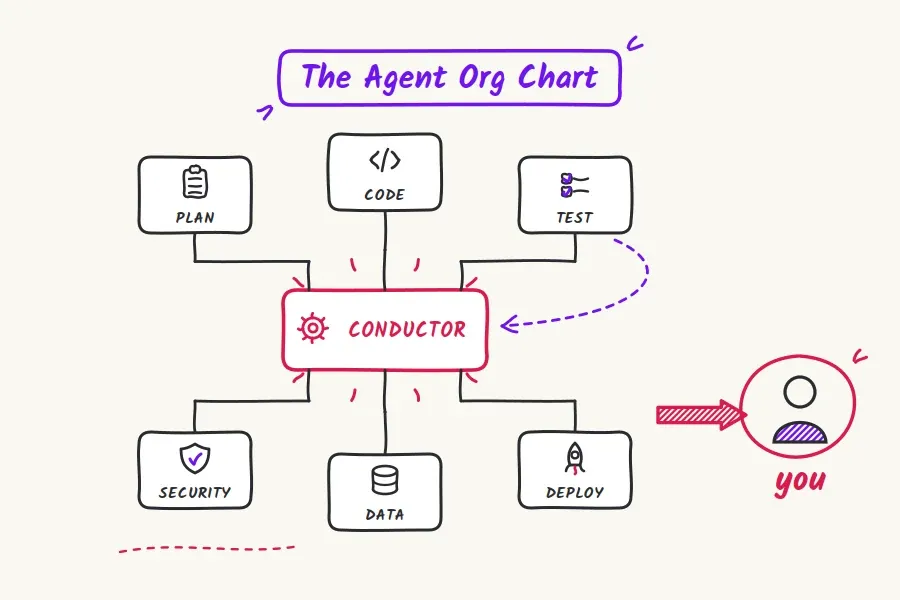
The teams that stall at DL4 are the ones that built coders and skipped the conductor and the governance. They have sixteen agents writing code and nothing managing them, so velocity goes up and trust goes down, and they quietly roll the whole thing back.

Here is the trade-off the demos skip: a fleet amplifies whatever you give it. A good rule propagates to sixteen agents instantly. So does a bad one. Without the learning loop and the review gate from DL3, you are not scaling delivery - you are scaling your worst assumption sixteen times over.

The trade-off nobody mentions

Here is the part the hype skips. A strong shared brain is the thing that moves you from 1.2x to 2x, but lean on compound context alone and you slowly stop questioning it. The brain encodes how you did things, which quietly becomes how you always do things. That is great for consistency and quietly corrosive to invention.

Treat steps 4 and 5 as non-negotiable, not optional hygiene. The review gate keeps a bad rule from metastasizing across every session. The pruning keeps the brain from calcifying into dogma. A brain you never challenge is just yesterday's assumptions running at machine speed.

1.2x is where individual prompt skill plateaus. 2x is what a shared, versioned brain unlocks.

This is the step before agentic development

Regardless of the model, and yes, my example runs on CLAUDE.md, this is the work you do before you reach for Loops and Goals. It is not glamorous. It will not trend. It is the difference between an agent that compounds your team's knowledge and one that confidently ships the same mistake twenty times while you are at lunch.

This is how you move from 1.2x to 2x efficiency. Not by buying a better tool. By building the context that makes any tool match your project.

The teams who built the BRAIN first are the only ones ready for agentic development.

Frequently asked questions

The BRAIN is one shared, versioned context that your whole team feeds: a CLAUDE.md, a .claude/ folder, a .cursorrules file, or equivalent. It holds your critical rules (security, code style, CI/CD, stack) and the corrections from every session, so the AI matches your project instead of guessing at it. It is the artifact that gets a team to DL3.

DL3 is the delivery-readiness level where AI actually understands your project. DL1 is individual prompting; DL2, where roughly 70% of teams sit, is AI helping per-developer and per-session with nothing compounding. DL3 is the jump that ends the chaos, because it replaces scattered, in-the-head context with one shared, versioned brain. It is also the prerequisite for trustworthy agentic delivery.

Because the tool was never the unit of progress, delivery is. Standardizing the IDE, model, and license is the common first instinct, and it does not remove the chaos. What removes the chaos is shared context. A team can ship cleanly across different tools if they all feed the same brain; identical tooling with no shared context still drifts.

It is the step that moves a team from roughly 1.2x to 2x. Individual prompt skill plateaus early; the next gain comes from compounding team knowledge in a shared, versioned context. But note the trade-off: relying on compound context alone can suppress new thinking, which is why reviewing and pruning the brain are non-negotiable.

No. The example here uses CLAUDE.md, but the approach is model-agnostic. Whether you run Claude, Cursor, Copilot, or something else, the work is the same: build a single shared context, write your critical rules, wire a feedback loop, gate changes like production code, and prune regularly.

A brain encodes how you have done things, which can quietly become how you always do things: great for consistency, corrosive to innovation if left unchecked. A bloated brain also stops being read by the model. That is why the last two steps matter: review every change like production code so a wrong rule cannot spread, and prune regularly so the context stays sharp, current, and small.

Dimitar Siljanovski

Founder and CEO of Intertec.io

Dimitar is the Founder and CEO of Intertec, a custom software development company serving the DACH region. He writes about AI in software engineering, context engineering, and the gap between AI hype and production reality.

Let's talk about your project

Legacy modernization, custom development, or AI, we help companies ship software that drives real business outcomes.

View all posts