Industrial IoT Services That Transform Operations & Drive Results
Unlock real-time insights, automation, and control with powerful industrial IoT services designed to transform how your business operates. From smart factory solutions to energy and ESG reporting, our IIoT services are built to scale.
years of experience with DACH clients
projects delivering quality
satisfied clients coming from various industries

years of experience with DACH clients
projects delivering quality
satisfied clients coming from various industries
Industrial IoT Solutions For Different Sectors
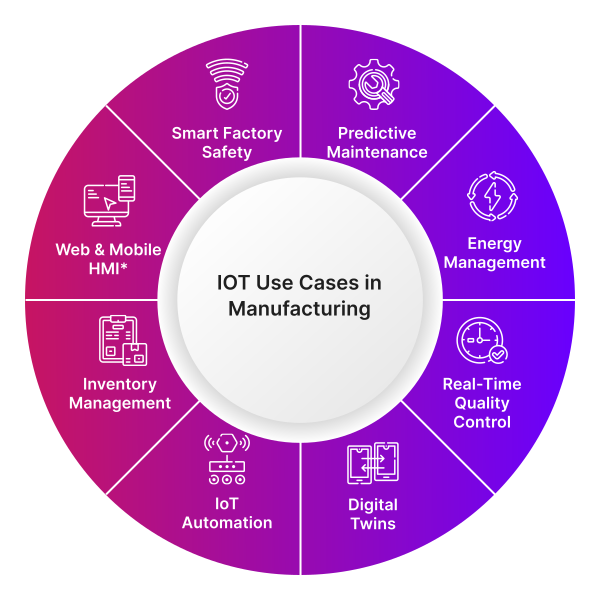
Reimagine production with scalable IoT in manufacturing solutions:
- Alert Management System
- Operational Dashboards
- Intelligent Process Automation
- Machine-to-Machine Communication
- Remote Control & HMI
These are the building blocks of smart manufacturing technologies and next-gen digital twin technology.
Reimagine production with scalable IoT in manufacturing solutions:
- Alert Management System
- Operational Dashboards
- Intelligent Process Automation
- Machine-to-Machine Communication
- Remote Control & HMI
These are the building blocks of smart manufacturing technologies and next-gen digital twin technology.
Turn Your Products Into Smart, Connected Solutions
The internet of things industry is reshaping how businesses operate. From machine-to-machine communication to digital twin technology, modern industrial IoT solutions are no longer optional - they’re your edge.

How IoT Solutions Work
Turning IoT Data into Actionable Insights with 4 Easy Steps
Devices & Sensors
Monitor performance, flag maintenance needs, track product flow, and interact with users - all in real time.
Data Transfer
Secure communication over edge/cloud infrastructure (AWS, Azure, DataMiner) via MQTT, HTTP, COAP, AMQP, and more.
Insights & Dashboards
Use AI and application enablement to gain a 360° view of operations - from product quality to shipping timelines.
Automation & Optimization
Enable smart manufacturing technology with data-driven workflows that cut costs, eliminate manual checks, and streamline forecasting, supply, and delivery.
Insights Into Our Work
Monitoring Cuts Downtime by 50% for Swiss Industrial Leader
A prominent industrial gas flow systems provider faced significant operational inefficiencies and downtime due to a lack of remote monitoring. Intertec implemented a comprehensive IoT-driven solution, resulting in a 50% reduction in downtime, a 50% increase in operational efficiency, and a 30% decrease in maintenance costs.

Frequently Asked Questions
Before You Start
A normal software project ends at the screen. Industrial IoT ends at a machine on your floor.
Standard software lives on servers and screens. Industrial IoT reaches into the physical world: sensors on equipment, controllers on a production line, devices in the field that have to keep running through heat, vibration, and patchy connectivity. The software is only half the job. The other half is making it trustworthy when it is wired to something that physically moves, heats, or stops.
That changes the risk. A bug in a dashboard is an inconvenience. A device that misreports a temperature, or a firmware update that bricks a controller, stops production. We build for that from the first decision: what happens when the network drops, when a device fails, when you need to update a thousand of them at once without sending an engineer to each one.
Readiness is rarely the problem. A clear reason to connect anything is.
Most companies already have machines, products, or processes that could be monitored or controlled remotely. The hardware is ready. What is usually missing is the answer to a sharper question: what does connecting it actually change for the business? Lower downtime, less manual work, a new revenue stream, data you can finally act on.
If you can name the outcome you are chasing and point to the equipment or process that produces it, you are ready. If you cannot, more sensors will not help. That is what Discovery is for. We map where connectivity pays off and where it only adds cost, before you commit to building anything.
“Fine” is a snapshot. Your competitors are watching a film.
Your operation can run perfectly today and still be losing ground you cannot see. The machine that fails next month is sending warning signs right now that nobody is reading. The competitor who connected their line last year already knows their true cost per unit, their real downtime, their actual yield. You are estimating what they are measuring.
The question is not whether you can keep operating as you are. It is how long that gap stays survivable. Connect on your terms and you choose what to measure and when. Wait, and a failure, an audit, or a competitor's pricing chooses the timing for you.
You are in good company. Most first IoT attempts stall in the same place.
A pilot that proved the technology but never scaled. A wall of dashboards nobody opens. Sensors installed, data collected, and no decision ever changed because of it. These are normal starting points for us, not warning signs. A stalled IoT project is almost never a hardware problem. It is a scoping problem: the pilot was built to prove data could be collected, not to change a specific decision or remove a specific cost.
Discovery is built to find exactly where the last attempt lost the thread and plan around it. We start from what you already have on the floor, not from a blank slate.
Technical Details
Almost never. The machine that works is the one we connect, not the one we replace.
Most industrial equipment, even decades old, can be connected without being replaced. We read from existing controllers and protocols, add sensors where a machine cannot report on its own, and bridge older equipment into a modern data layer. Ripping out working machinery is the most expensive way to start, and usually the least necessary.
Where a machine genuinely cannot be instrumented, we tell you plainly and price the alternative. You decide with the real numbers in front of you, not after the budget is already spent.
Most downtime is predictable. You just cannot see it coming yet.
A machine that fails without warning costs you twice: the stopped production, and the scramble to fix it. Connected equipment changes the order of events. You see the vibration, temperature, or cycle count drifting out of range days before the breakdown, and you schedule the fix on your terms instead of reacting to an outage.
The same data removes the manual work around it. No one walks the floor logging readings. No one drives to a remote site to check status. The system watches continuously and asks for you only when something actually needs you.
Every connected device is a door into your network. The question is who holds the key.
Security cannot be bolted on after the devices are talking. It is designed in from the first architecture decision: data encrypted in transit and at rest, devices that prove their identity before they join, and access scoped so each person and system sees only what they should.
Your data stays yours. We build to the standards your industry runs on, IEC 62443 for industrial systems and ISO 27001 for information security, and we architect for European data residency rules so the data your devices generate stays where regulation and your own policy require it. We are GDPR-native, with data sovereignty as the default rather than a feature you have to ask for later.
Wherever your regulation, your latency, and your policy say it should. Not wherever a vendor finds convenient.
Some data has to be processed on the machine itself, in milliseconds, because waiting for a round trip to the cloud is not an option for a control decision. Some has to stay inside your walls or inside specific borders for compliance. Some belongs in the cloud for long-term analysis. We design the split deliberately, across the edge, on-premise, and the cloud, based on what each piece of data is actually for.
Your data stays yours. We are GDPR-native and build with data sovereignty as the default, so your operational data does not quietly become someone else's training set or get locked inside a platform you cannot leave.
The right stack is the one your team can still run after we leave.
So we do not pick it on day one. The decision comes after Discovery, once we know what your equipment speaks, where your data has to live, and what your team will maintain for years. We work across the common industrial protocols and modern data infrastructure: MQTT, OPC UA, and Modbus on the device side, edge gateways, time-series databases, and cloud platforms for analysis.
The protocols matter less than the order. Decide the technology before you understand the equipment, and you have already made your first expensive mistake.
Process, Cost & Risk
The most expensive IoT mistakes happen before a single sensor is installed. Discovery is how we avoid them.
For one to two weeks, our team works alongside yours to map what you actually have: the equipment, the protocols it speaks, the workflows around it, and the decision you are trying to improve. It surfaces the integration risks, the data nobody is capturing, and the assumptions that would otherwise turn into a warehouse of unused sensors.
Think of it as the cheapest insurance on the project. It routinely pays for itself by killing the ideas that sound good in a meeting and fall apart on the floor.
The return does not come from the sensors. It comes from what you stop doing manually.
The useful question is not “what is the ROI of IoT.” It is “what is each hour of unplanned downtime, each manual inspection, each trip to a remote site costing me today?” Connect the right equipment and those numbers drop. Predictive maintenance catches a failure before it stops a line. Remote monitoring ends the drive to read a gauge in person.
We do not quote a generic payback window. After Discovery, you get a phased plan where each milestone ships working software tied to a specific saving, and you pay when it is delivered. You watch the return accrue phase by phase, not on a slide before the work starts.
You pay when working software ships, not when hours pile up.
Our invoices say “delivered,” not “hours worked.” Milestone-based pricing puts our incentives on yours: ship working capability efficiently, do not stretch the timeline. After Discovery, you get a phased plan with clear milestones, team composition, and a fixed cost for each phase. You see exactly what you are paying for at every stage.
Hardware is the one place where real-world costs are real-world costs, and we show that line separately and plainly. The engineering, you pay for on delivery.
Long enough to do it right. But you see value in weeks, not years.
After a one-to-two-week Discovery, we deliver working capability in phases instead of disappearing for a year and returning with a finished platform. The first connected line, the first dashboard your operators actually use, the first prevented failure: these land early. Your risk drops with every phase.
The total depends on how many machines you are connecting, how many protocols are in play, how much has to run at the edge, and the state of your network on the floor. We give you a realistic range after Discovery, not a number guessed before we have seen your equipment.
“The sensors are live” is the floor, not the goal.
We set measurable targets at the start, tied to what you actually care about: less unplanned downtime, lower cost per unit, fewer manual inspections, faster response when something drifts, and operators who trust the system enough to act on it. A dashboard nobody opens is a failed project, however well it is built.
The target that matters most is the same one as always: your team's ability to run and extend the system once we are gone.
Why Intertec
You can. The question is whether you want to spend a year building a team for a capability you need now.
Industrial IoT needs a rare mix: embedded and firmware, networking, cloud, data engineering, and security, plus people who are comfortable on a factory floor. Hiring that blend in the DACH region takes the better part of a year, and the whole time you are running a hiring program instead of connecting your operation.
We bring a team that has done this across industries, working alongside your people from day one, so the knowledge stays with you. You reach production faster, at lower risk, without permanently growing headcount for a capability you may need most intensely just once.
Five things, and they are the five things our competitors cannot put on their own website.
You pay on delivery. Milestones, not hours. Our invoices say “delivered.”
Discovery comes first. One to two weeks understanding your equipment and your goal before we propose anything, which kills the assumptions that turn into unused hardware.
The team stays. Under 5% turnover on long engagements. The engineer who maps your floor in month one is the one deploying the system later.
Your data stays yours. At the edge or on-premise where you need it, GDPR-native, NIS2-ready by default.
We build products, not pilots. We understand device fleets, firmware updates, and what it takes to keep a thousand devices running in the field, so your connected system survives contact with the real world.
A lot, and not for the reason most vendors think.
DACH companies operate under GDPR and NIS2, and they expect Planungssicherheit: structured, predictable planning that leaves no room for nasty surprises. With IoT, where a partner suddenly has access to your operational data and your shop floor, that discipline is not a nice-to-have. A vendor who treats compliance and data residency as an afterthought creates more risk than they remove.
Our processes, our contracts, and our delivery model are built for this market, not adapted to it after the fact.
Getting Started
Not the hardware. Not the platform. The reason.
The most expensive connected products are the ones built before anyone agreed what they were for. Choosing sensors and a cloud stack on day one locks cost and architecture around assumptions you have not tested. The first step is deciding what the product has to achieve: better performance in the field, a service you can charge for, data that makes your next product better.
Once that is clear, you build a focused first version that proves it, not a full platform. Hardware, connectivity, and data infrastructure all line up behind that one goal. That is where we start every engagement: understand the outcome before choosing the technology, so the first thing you ship is the thing that earns its cost.
Thirty minutes. No pitch, no slides.
We ask about your operation, your equipment, your team, and what is not working. You ask us anything you want. By the end, we both know whether IoT makes sense for you, and if it does, Discovery is the next step.
Some companies find they are not ready yet. Others find the path is clearer than they feared. Either way, you leave with more clarity than you came in with. The call is run by senior engineers, not salespeople.
Then Discovery is exactly where you should start.
It is low-commitment and fixed-price, built to give you clarity: what is possible, what it realistically costs, what the timeline looks like. You get all of that whether or not you go forward with us.
Nothing formal. No diagrams, no equipment inventory.
If you can describe what you make or operate, which machines or processes frustrate you, and what you wish you could see or control, that is plenty for a productive first call.
We have had great conversations with plant managers who arrived with detailed equipment lists, and equally good ones with executives who just said, “we have no idea what our real downtime is and that scares us.” Both are a fine place to start.
Book a Free Consultation
Trusted by leading businesses worldwide