The Rise of AI-Powered Smart Factories
Something big is happening on the factory floor. And it is not just robots and conveyor belts anymore.
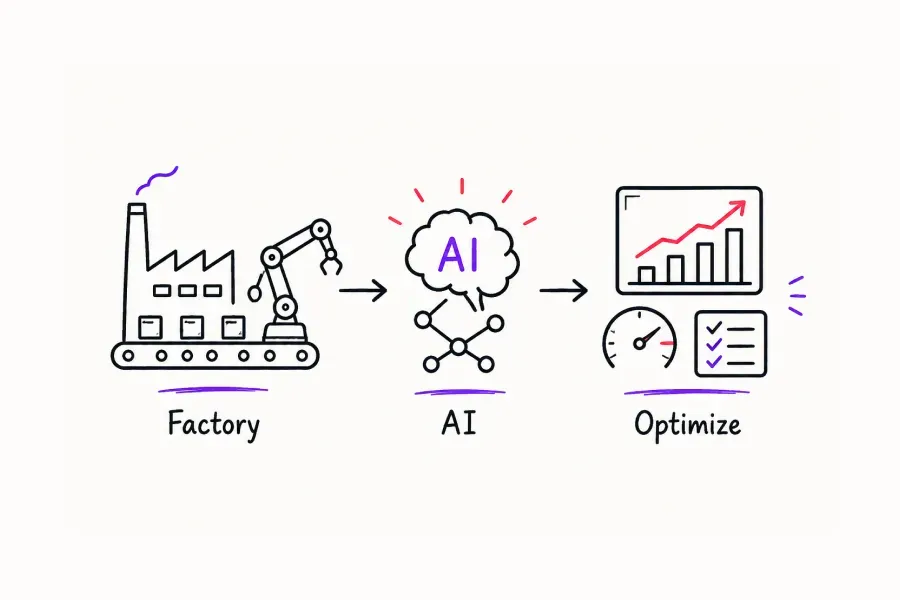
Digital transformation is reshaping how industrial operations function. From the moment raw materials arrive to the second a finished product ships, AI in smart manufacturing is rewriting the rules of production. We are no longer talking about isolated automation tools. We are talking about intelligent, connected systems that learn, adapt, and optimize in real time.
So, where does AI fit into the bigger picture? AI in smart manufacturing sits at the heart of Industry 4.0 — the fourth industrial revolution. Industry 4.0 refers to the integration of digital technologies like IoT sensors, cloud computing, robotics, and AI into manufacturing processes. AI is the brain that processes the data these technologies generate and turns it into decisions.
The numbers tell a compelling story. According to MarketsandMarkets, the global AI in manufacturing market is expected to grow from USD 34.18 billion in 2025 to USD 155.04 billion by 2030, at a compound annual growth rate (CAGR) of 35.3%.
Manufacturers are not investing in AI just to keep up. They are investing because AI unlocks efficiency, resilience, and competitiveness that traditional methods simply cannot achieve. In this article, we break down exactly how AI in smart manufacturing works, where it delivers the most value, and what challenges you need to prepare for.
What AI in Smart Manufacturing Really Means
AI as the Brain of Industry 4.0
Let us start with a clear definition. AI in smart manufacturing refers to the use of artificial intelligence — including machine learning, computer vision, and advanced analytics — to automate decisions, optimize processes, and improve outcomes in production environments.
Think of a modern factory as a nervous system. IoT sensors act as the nerve endings. They collect data from machines, production lines, and environmental conditions. The data travels through connected networks to a central intelligence layer. That is where AI lives. It processes, learns, and acts.
Machine learning in manufacturing is particularly powerful here. Instead of following fixed rules, machine learning models analyze historical production data and find patterns. Over time, they improve. A system that monitors vibration patterns on a conveyor belt, for example, learns what "normal" looks like. When it detects an anomaly, it alerts the team before a breakdown occurs.
AI also plays a critical role in modern industrial automation environments. Traditional automation follows scripts: "If X happens, do Y." AI-powered automation goes further: "If X is trending, adjust Y proactively to prevent Z." That shift from reactive to predictive is transformational.
From Data to Actionable Intelligence
Smart factories generate an enormous amount of data. Machines, sensors, ERP systems, and production lines all produce continuous streams of information. However, raw data alone is not useful. What matters is what you do with it.
This is where smart manufacturing AI depends on strong data pipelines. A data pipeline is the pathway that moves data from sensors to storage to analysis. Without clean, reliable pipelines, AI models receive poor-quality inputs — and poor inputs lead to poor decisions.
Here is the typical flow in a smart factory:
- Sensors and IoT devices collect real-time machine data.
- Data pipelines route this information to cloud or edge computing systems.
- AI and analytics tools process the data and identify patterns or anomalies.
- Operational teams receive insights, alerts, or automated decisions.
- The system continuously learns from outcomes and improves over time.
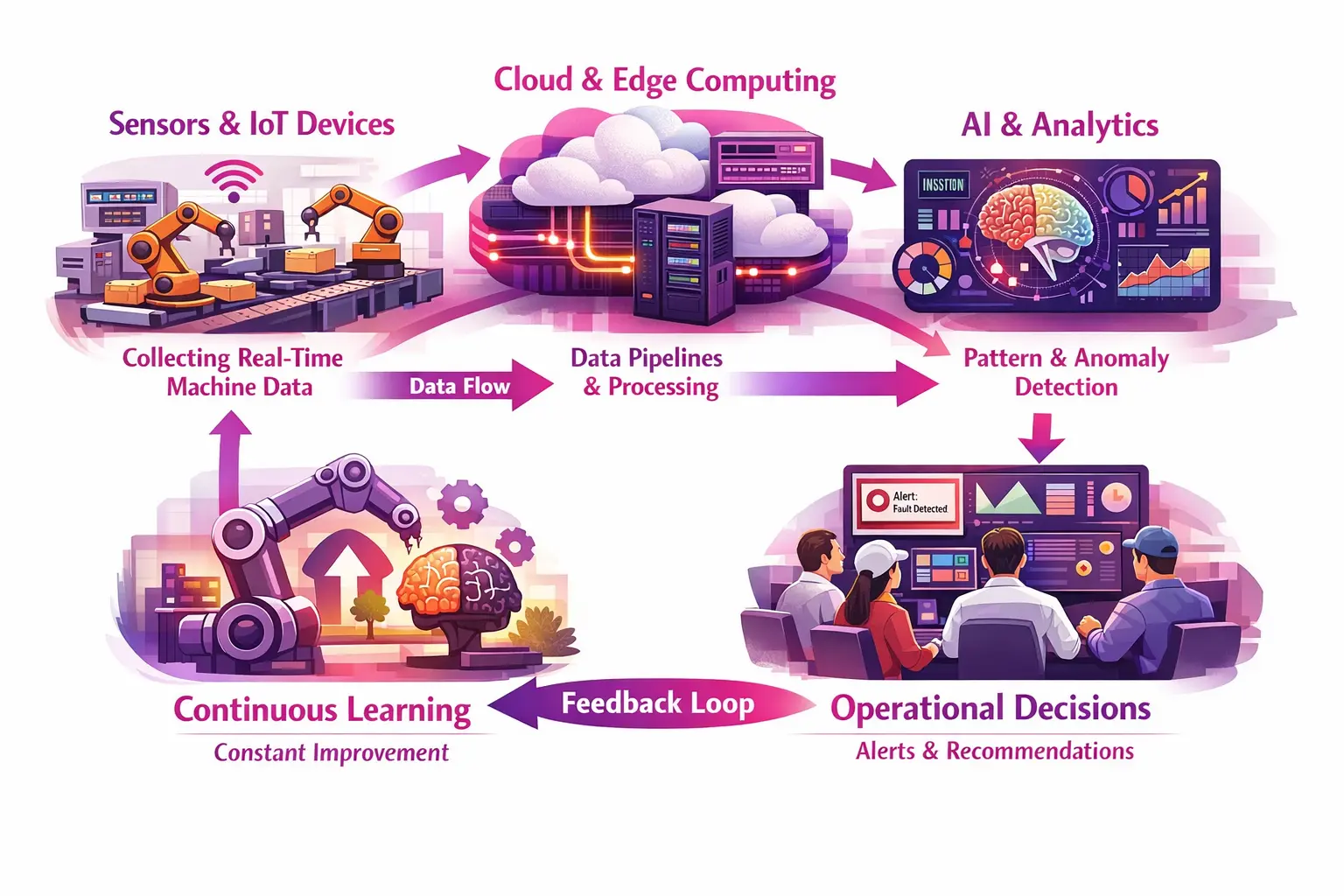
This cycle of data-to-intelligence-to-action is the foundation of AI in smart manufacturing. Without it, factories remain reactive. With it, they become proactive — and ultimately, self-optimizing.
Key AI Use Cases in Smart Manufacturing
1. Predictive Maintenance and Equipment Reliability
Unplanned downtime is one of the costliest problems in manufacturing. Aberdeen Group research shows that unexpected equipment failures can cost organizations up to $260,000 per hour. For large industrial operations, that number can climb to $532,000 per hour.
Downtime costs have risen sharply. While a 2016 Aberdeen report estimated costs at $260k–$532k per hour, 2024 data from Siemens shows Fortune Global 500 companies now lose 11% of annual turnover, with automotive sector costs reaching $2.3 million hourly. (See full 2024 report at Siemens).
Predictive maintenance changes that equation entirely. Instead of waiting for equipment to fail, AI monitors machine health in real time. It analyzes sensor data — vibration, temperature, pressure acoustic signals — and flags signs of wear or impending failure before they escalate.
"McKinsey research reveals that predictive maintenance strategies reduce overall maintenance costs by 18–25% while decreasing equipment downtime by up to 50%." — McKinsey & Company
Resources: Digitally enabled reliability: Beyond predictive maintenance | McKinsey | A smarter way to digitize maintenance and reliability | McKinsey
The real-world results back this up. Ford's machine learning models predicted 22% of specific component failures an average of 10 days in advance, with only a 2.5% false positive rate — saving approximately $7 million in costs for just one component type. Similarly, BMW's AI predictive systems generated timely alerts that prevented over 500 minutes of annual production disruption.
2. Production Optimization and Quality Control
Beyond maintenance, AI in smart manufacturing is transforming how production workflows operate. Traditional production lines follow fixed schedules. AI-driven systems adjust dynamically — shifting resources, reordering tasks, and optimizing throughput based on real-time conditions.
Quality control is another area where AI shines. Machine learning models can detect product defects far more accurately than human inspectors, and at a speed no manual process can match. Computer vision systems analyze thousands of items per minute, identifying flaws that are invisible to the naked eye.
For example, Micron Technology implemented AI-based computer vision in its silicon wafer manufacturing facilities. The system identifies imperceptible defects, significantly improving both quality and manufacturing efficiency. Similarly, a global automaker deployed deep learning models to analyze welding robot images, reducing robot inspection time by 70% and improving welding quality by 10%.
The cumulative impact is significant. AI-driven production optimization typically improves Overall Equipment Effectiveness (OEE) by 5–15%, directly boosting productivity and yield. For large facilities, that translates to millions in additional annual output.
3. AI Supply Chain Optimization
Supply chain disruptions have been one of the defining business challenges of this decade. AI supply chain optimization gives manufacturers the tools to anticipate disruptions, not just react to them.
AI models analyze historical demand data, market signals, and external factors to forecast demand with far greater accuracy than traditional methods. This, in turn, enables smarter production scheduling — manufacturers produce what is needed, when it is needed, reducing both excess inventory and stockouts.
Furthermore, the economic opportunity from Generative AI extends well beyond any single sector. According to McKinsey's The Economic Potential of Generative AI report, the technology could deliver value equal to an additional $200 billion to $340 billion annually for the banking industry alone — and $400 billion to $660 billion a year for retail and consumer packaged goods — if use cases were fully implemented. For manufacturers operating at the intersection of production, logistics, and supply chain, that scale of potential value signals a compelling reason to act now.
AI Technologies Powering Smart Factories
1. Machine Learning and Advanced Analytics
Machine learning is the engine driving most AI use cases in smart manufacturing. ML algorithms find patterns in large datasets that humans cannot detect manually. In production environments, this means:
- Pattern recognition in sensor data to predict equipment failures.
- Predictive modeling that guides operational decisions — from scheduling to maintenance.
- Continuous improvement through systems that learn from new data over time.
By technology, the machine learning segment holds the largest market share in AI manufacturing solutions. This makes sense — ML underpins nearly every intelligent decision a smart factory makes.
2. Computer Vision and Industrial AI
Computer vision is AI's ability to see. In manufacturing, it means cameras and sensors feed visual data to AI models that interpret what they see and take action.
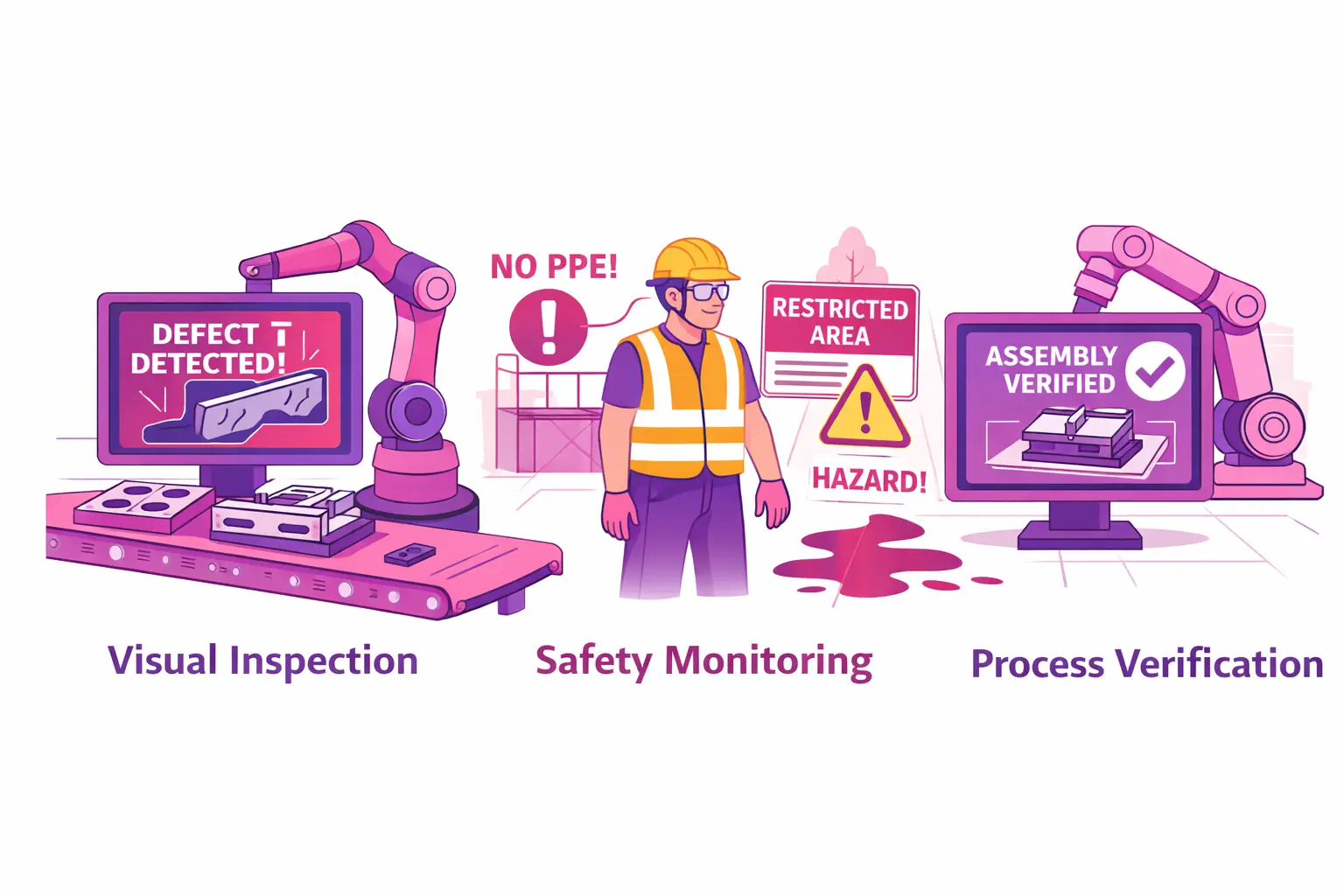
Here is where computer vision creates value on the factory floor:
- Visual inspection: Automated systems detect surface defects, dimensional errors, or assembly mistakes at production speed.
- Safety monitoring: AI identifies unsafe conditions — workers in restricted areas, PPE violations, or hazardous spills — and triggers alerts.
- Process verification: Vision systems confirm that assembly steps are completed correctly, replacing time-consuming manual checks.
According to Grand View Research, artificial intelligence in manufacturing market size was estimated at USD 5.32 billion in 2024, with production planning and computer vision applications leading adoption. The technology is advancing rapidly, and its use cases expand with every year.
3. Edge AI and Real-Time Industrial Automation
Edge AI refers to running AI processing directly on factory equipment — on the machine or sensor itself — rather than sending data to a central cloud server. This matters enormously in industrial settings where decisions must happen in milliseconds.
Consider a quality control camera on a high-speed production line. Sending each image to a remote server for analysis introduces latency. Edge AI processes the image locally, instantly. The line can reject a defective item before it moves to the next station.
Edge AI also reduces bandwidth costs and improves data security. Sensitive production data stays on-site. Moreover, integrating edge AI into industrial automation systems enables factories to operate more autonomously, with less reliance on human intervention for routine decisions.
Vendors are now embedding private 5G and edge analytics into new factory equipment, enabling micro-second response times for safety-critical processes. This is fast becoming a key differentiator for smart manufacturing leaders.
Challenges in Implementing AI in Manufacturing
1. Data Integration and Legacy Systems
Here is the honest truth: most factories were not built for AI. Legacy equipment runs on older control systems that were never designed to share data. Connecting these systems to modern AI platforms is often the hardest part of a smart manufacturing initiative.
Industrial IoT platforms bridge this gap, but integration takes time and investment. Operational Technology (OT) systems — the software controlling physical machines — must be carefully connected to IT systems without compromising safety or performance. Getting this integration right is critical, because AI is only as good as the data it receives.
2. Organizational and Workforce Challenges
Technology alone does not transform a factory. People do. Yet many manufacturing workforces lack the digital skills needed to operate AI-powered systems confidently.
Upskilling employees is therefore just as important as deploying new technology. Workers need to understand what AI tools do, trust their outputs, and know when to override them. Similarly, IT, engineering, and operations teams often work in silos — and AI initiatives require all three to collaborate closely. Bridging these cultural and organizational divides is essential for sustainable transformation.
3. Scaling AI from Pilot to Production
Many manufacturers successfully run AI pilot projects. Far fewer successfully scale them. Pilots often run in controlled environments with dedicated support. Production rollouts face far messier realities: inconsistent data quality, integration complexity, and organizational resistance.
The manufacturers that succeed at scale treat AI deployment as a strategic program, not a one-off project. That means establishing governance frameworks, defining clear performance metrics, and creating feedback loops that allow AI models to improve continuously. Moving from proof-of-concept to full deployment requires patience, strong leadership, and a clear business case at every stage.
The Future of Smart Manufacturing with AI
Where is all of this heading? The trajectory is clear: toward greater autonomy, greater intelligence, and greater collaboration between humans and machines.
In the near term, we will see more autonomous production lines — systems that self-adjust, self-diagnose, and self-optimize without constant human oversight. Xiaomi's fully automated smartphone factory in Changping, China, already produces one device per second with minimal human involvement, guided entirely by proprietary AI systems.
Digital twins — virtual replicas of physical assets — will become standard tools. As these models grow more sophisticated, they will allow engineers to simulate changes before implementing them, dramatically reducing risk.
AI will also deepen its role in AI in Industry 4.0 transformation more broadly. The convergence of AI, 5G connectivity, advanced robotics, and sustainable manufacturing practices will define the next generation of industrial operations. Manufacturers that build strong AI foundations today will be far better positioned to adopt whatever comes next.
Conclusion: AI as the Foundation of Next-Generation Manufacturing
Let us bring it all together.
AI in smart manufacturing is not a future concept. It is happening right now, in factories across every major industry — finance, healthcare, logistics, automotive, and beyond. From predictive maintenance that prevents costly breakdowns to AI supply chain optimization that builds resilience, the use cases are proven and the ROI is measurable.
However, technology alone is not enough. Successful AI in smart manufacturing requires strong data pipelines, organizational alignment, and a clear strategy for scaling from pilot to production. Manufacturers that get these foundations right will gain sustainable competitive advantages that are very difficult to replicate.
The factories of tomorrow will not just be automated — they will be intelligent. And that intelligence starts with the decisions you make today.
Ready to explore how AI in smart manufacturing can transform your operations?
We would love to talk. Whether you are just starting your Industry 4.0 journey or looking to scale an existing AI initiative, reach out to us to discuss how we can work together. Our team brings deep experience in AI strategy, industrial automation, and digital transformation. We are passionate about helping manufacturers compete in an increasingly intelligent world.
Explore our Generative AI Services to see how we can help you build smarter, more resilient production systems. Get in touch with us today and let's start the conversation."
Found this article valuable?
Share it with your network. If this article gave you clarity on AI in smart manufacturing, pass it along to a colleague who is navigating the same challenges. A quick share could spark a conversation that changes how their factory operates.