Time and Materials vs. Fixed Price: Which Contract Model Reduces Financial Risk?

Published Mar 31, 2026 | 17 min read


When most people debate time and materials vs. fixed price, they frame it as a project management question. Which model fits our workflow? Which one suits our development team? Those questions matter - but they miss the bigger point.

For a CFO or finance leader, the real question is this: where does the financial exposure sit? Contract structure determines who absorbs cost overruns, who carries the risk of changing requirements, and how predictably capital gets deployed. That makes it a financial governance decision first and a delivery preference second.

The numbers demand attention. According to the Project Management Institute's Pulse of the Profession, organizations waste an average of 11.4% of investment due to poor project performance. For a company spending $50 million annually on software development, that is $5.7 million lost every year - often because the wrong pricing model was chosen for the wrong type of project.

In this article, we will break down both models honestly. We will examine where the financial risk actually lives, what the data shows about cost overruns, and how a risk-aware finance leader should evaluate the choice between a fixed price contract and a time and materials contract.

The contract model does not remove financial risk. It decides who holds it - and under what conditions it surfaces.

— Core principle for risk-aware finance leaders

Understanding the Two Models Through a Financial Lens

Fixed Price Contracts: Apparent Certainty, Hidden Variables

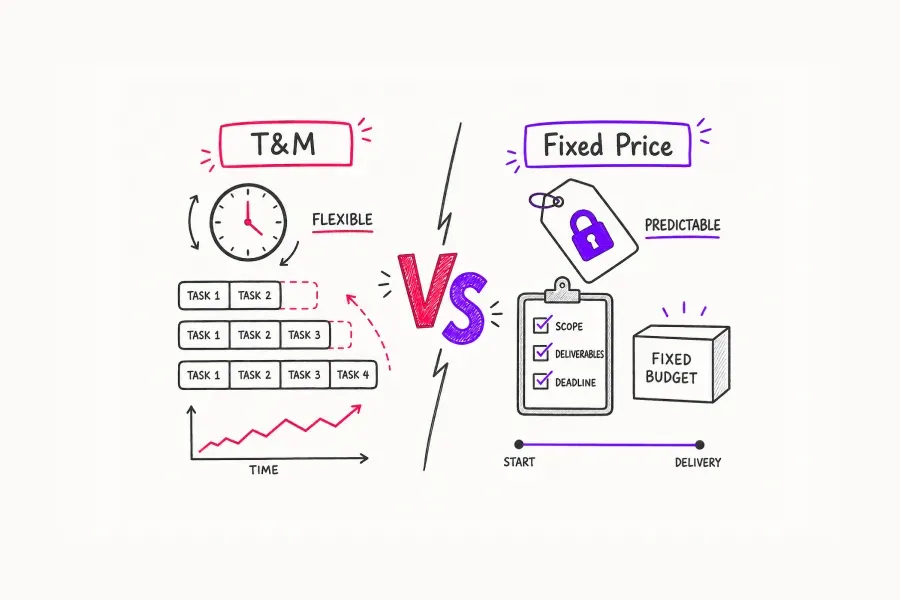
A fixed price contract sets a single, predetermined total cost for the entire project before work begins. The appeal is obvious: the client pays a known amount, the service provider delivers a defined scope, and the budget line stays clean on paper.

However, the fixed price model only works as advertised when the project scope is completely stable and requirements are fully defined upfront. In custom software development, that is rarely the case. Requirements evolve. Technologies shift. Business priorities change mid-build. When those things happen inside a fixed price agreement, the financial exposure does not disappear - it just moves.

Here is the mechanism most finance teams miss: vendors building fixed price projects routinely embed a 15 to 30 percent risk premium into their quoted price to protect themselves against uncertainty. This is an industry-standard buffer that clients pay regardless of whether those risks materialize. So even before a single line of code is written, a fixed price contract may already cost significantly more than an equivalent time and materials engagement.

There are also structural limitations to consider. Fixed price contracts require a long and detailed planning phase before work begins. Every requirement must be documented, agreed upon, and locked in. Change order management becomes administratively complex and expensive. When the project evolves - and in software, it almost always does - clients face a difficult choice: pay for expensive change requests, or accept a final product that no longer reflects their actual needs.

Fixed price contracts offer genuine benefits in the right context. They provide upfront budget visibility. They transfer cost overrun risk to the vendor. They simplify internal approval processes because the total cost is known at signing. For well-defined projects with a stable scope and fixed deadlines, they can be the right choice.

However, the key phrase is well-defined scope. Without it, the apparent certainty of a fixed fee contract quickly becomes an illusion.

Fixed Price Contract: Pros and Cons at a Glance

ProsCons

Upfront budget certainty and a known final price

Risk premium of 15 to 30 percent is typically embedded in the final price

Vendor absorbs cost overrun risk within the agreed scope

Inflexible when project requirements change after signing

Simpler internal approval and CapEx planning

Change requests are costly and generate contract disputes

Less ongoing client involvement required during development

Requires exhaustive upfront documentation before work can start


Higher risk of project failure if collaboration is discouraged to protect margins

Time and Materials Contracts: Transparency With Variable Spend

In a time and materials contract, the client pays for the actual time worked and materials used - calculated at an agreed hourly rate. There is no fixed final cost determined at the outset. Instead, the total cost of the project is shaped by the actual hours spent and the decisions made along the way.

This structure aligns naturally with how modern software development actually works. Requirements evolve. New information emerges during the development process. Teams using agile methodologies operate in iterative cycles where priorities shift between sprints. A time and materials model accommodates that reality without generating expensive change orders every time the project's direction adjusts.

The main concern finance teams raise about time and materials contracts is understandable: without a fixed budget, how do we control spend? This is a legitimate question, and the honest answer is that control comes from governance, not from the contract structure itself.

Several mechanisms protect financial exposure in a time and materials engagement. A not-to-exceed clause caps total spend at a defined ceiling. Monthly budget reviews and sprint-based reporting keep actual hours visible in near-real-time. Clearly defined milestones tie spending to measurable outcomes. When these controls are in place, a time and materials model can offer stronger financial transparency than a fixed price contract - because every cost is visible rather than bundled into an opaque fixed fee.

The Standish Group's CHAOS Report has consistently found that only around 31 percent of software projects finish on time and on budget. A large portion of the failures occur in fixed price engagements where the scope was not as stable as assumed at signing. Time and materials projects, by contrast, allow adjustments before small problems become expensive derailments.

Time and Materials Contract: Pros and Cons at a Glance

ProsCons

Full transparency - the client pays for actual time spent, not inflated estimates

Total project cost is not known at the start

High flexibility to adjust project scope as the project evolves

Requires ongoing client involvement and communication

Aligns naturally with agile and iterative development approaches

Demands rigorous record-keeping - timesheets, invoices, progress reports

Reduces friction and cost of change request management

Without governance controls, spend can drift beyond expectations

Clients can redirect resources toward higher-priority work at any time


Head-to-head: Where Financial Risk Actually Lives

Risk FactorFixed PriceTime & MaterialsWho Has the Edge?
Scope change costHigh — change ordersLow — adjust freelyT&M wins
Upfront cost certaintyHigh — known totalLow — variable spendFixed wins
Vendor risk premium15–30% embeddedNoneT&M wins
Budget overrun visibilityHidden in change ordersVisible in real timeT&M wins
CapEx classificationEasierHarderFixed wins
Total cost of ownershipOften higherOften lowerT&M wins
Project failure riskHigher (rigid scope)Lower (adaptable)T&M wins
Governance dependencyLowerHigherContext-dependent

1. Forecast Accuracy and Budget Predictability

Fixed price contracts are often chosen because they appear to improve forecast accuracy. The budget is set. The number is in the plan. Finance can close the book. But this perception of certainty can be dangerous - because it assumes the scope defined at signing is the scope that will be delivered.

Research from McKinsey & Company shows that large IT projects run an average of 45 percent over budget and 7 percent over schedule - while delivering 56 percent less value than originally projected. The majority of those overruns are not caused by the contract model. They are caused by scope instability, poor requirement definition, and weak change order management. Those factors exist in both fixed price and time and materials engagements.

The difference is how the overrun surfaces. In a fixed price contract, unexpected costs appear as change orders - separate line items that are negotiated, disputed, and processed outside the original budget. In a time and materials contract, cost variance is visible on the invoice in real time. One model hides the problem; the other surfaces it immediately.

For a finance team focused on genuine forecast accuracy, real-time visibility into actual costs is more valuable than a fixed number that may shift unpredictably through change orders.

2. CapEx vs. OpEx Considerations

One factor that genuinely favors fixed price contracts in certain organizations is accounting classification. Fixed price agreements are often easier to classify as capital expenditure (CapEx), because the total cost is defined, the deliverable is discrete, and the investment has a clear useful life. That classification can benefit organizations with strong CapEx budgeting cycles or those seeking to capitalize software development costs under applicable accounting standards.

Time and materials engagements, by contrast, often blend into operating expenditure (OpEx) because costs are ongoing and variable. This is not inherently negative - in fact, for organizations that prefer to keep software development costs off the balance sheet or maintain greater liquidity flexibility, the OpEx treatment of time and materials spend may be strategically preferable.

The right answer depends on your organization's balance sheet priorities, tax position, and budget structure. Neither model is universally better from an accounting standpoint - but the classification implications should be part of the contract decision.

3. Total Cost of Ownership and Long-Term ROI

When evaluating time and materials vs. fixed price, many finance teams focus on the initial contract value. That is the wrong number to anchor on. The right measure is total cost of ownership (TCO) - the full cost of building, maintaining, and evolving the software over its lifetime. Gartner research consistently highlights that downstream maintenance and integration costs often dwarf the original development budget.

Fixed price contracts can increase TCO in two specific ways. First, vendors under margin pressure in a fixed price project may cut corners to protect profitability - delivering a technically functional product that is brittle, poorly documented, or difficult to extend. Second, because fixed price projects discourage change during development, the final product may be misaligned with what the business actually needs by the time it launches, requiring expensive rework.

Time and materials contracts, by contrast, allow the team to prioritize quality and adaptability throughout the development process. The final product tends to be better aligned with actual business needs - reducing rework costs and extending the useful life of the investment. That translates directly into stronger long-term ROI.

"In a fixed price contract, unexpected costs appear as change orders. In a time and materials contract, cost variance is visible on the invoice in real time. One model hides the problem. The other surfaces it immediately."

— Core distinction for CFOs evaluating contract risk

Risk Management Controls That Matter More Than the Model

1. Governance and Financial Oversight

Here is the most important thing we can say about managing financial risk in software development: the governance framework matters more than the contract type. A well-governed time and materials project will outperform a poorly governed fixed price project on every financial metric - cost control, forecast accuracy, and ROI.

Effective financial oversight means setting executive checkpoints at defined milestones. It means requiring that every invoice is tied to a deliverable or a measurable output. It means using project management software to track actual hours worked against budget in real time. And it means having an escalation protocol that surfaces financial risk before it becomes a budget crisis.

The Project Management Institute reports that organizations with mature project governance complete 89 percent of projects on time and within budget - compared to just 36 percent for low-maturity organizations. That 53-percentage-point gap is driven by governance, not by contract choice.

2. Scope Discipline and Change Management

Whether you choose a fixed price or time and materials model, scope discipline is non-negotiable. In a fixed price contract, it protects against expensive change orders. In a time and materials contract, it prevents budget drift. In both cases, the mechanism is the same: a structured change request process that evaluates every proposed addition against cost, timeline, and business value before it is approved.

Every change request should answer three questions before getting approved:

  1. What does this change cost in time, money, and resources?
  2. What business value does it deliver, and by when?
  3. Who has the authority to approve and fund it?

Without this discipline, both contract models expose the organization to the same financial risk: doing more work than was planned, without adjusting budget or timeline accordingly. That is scope creep - and it damages projects regardless of whether the contract is fixed price or time and materials.

3. Blended and Hybrid Approaches

In practice, the smartest organizations often do not choose between fixed price and time and materials - they combine both in a hybrid structure. The most common approach is a fixed price discovery phase followed by a time and materials development phase.

The discovery phase - typically a few weeks - uses a fixed fee to define requirements, validate assumptions, and produce a detailed project plan. This reduces the uncertainty that makes time and materials feel risky, while avoiding the premature scope lock-in that makes fixed price contracts dangerous. Once requirements are genuinely stable, the development phase can proceed on a time and materials basis with a not-to-exceed clause providing a spending ceiling.

This structure captures the best of both models: budget certainty where the work is well defined, and flexibility where it is not. It also tends to produce more accurate software development cost estimates, because the discovery phase surfaces assumptions that would otherwise remain hidden until they change orders.

Another hybrid variant worth knowing is the Quoted Time and Materials (QT&M) model. In QT&M, each task in the project backlog is assigned a fixed price before work begins. The client can add or remove tasks based on their budget, giving them both flexibility and cost predictability at the task level. This model is particularly effective in agile software development environments where requirements are modular and evolve incrementally.

Phase 1

Fixed Price Discovery

Phase 2

T&M Development

Phase 3

T&M with Not-to-Exceed

Decision Framework for the Risk-Aware CFO

Before approving any software development contract, a finance leader should work through the following questions. The answers will point toward the right pricing model more reliably than any rule of thumb.

Choose Fixed Price when…Choose T&M when…
Scope is fully defined before work startsRequirements are evolving or innovation-driven
Requirements are stable and unlikely to changeProject uses agile or iterative methodologies
Delivery timeline is fixed and non-negotiableBusiness priorities may shift during development
Project is small, self-contained, low uncertaintyMaximum transparency into costs is needed
CapEx classification is a priorityProject is large, complex, or technically novel
Limited capacity for ongoing involvementLong-term flexibility and lower TCO are priorities

Key Questions to Ask Before Signing Either Contract:

  1. Where does the downside risk sit — with us or with the vendor?
  2. How are unexpected changes priced and approved?
  3. How will financial exposure be monitored monthly?
  4. What mechanisms protect forecast accuracy as the project evolves?
  5. Is there a not-to-exceed clause, and what triggers it?
  6. What is the vendor's track record on budget adherence?
  7. How are service level agreements (SLAs) defined and enforced?

The answers to these questions will reveal more about your actual financial risk than the contract label ever will. A time and materials contract with strong governance controls is safer than a fixed price contract with weak ones. The model is a starting point, not a guarantee.

The Model Does Not Remove Risk - Governance Does

The debate over time and materials vs. fixed price is, at its core, a debate about where financial risk should sit and how it should be managed. Neither model eliminates uncertainty. Both models can lead to cost overruns, project delays, and misaligned final products - if governance is weak.

Fixed price contracts offer perceived certainty, but that certainty often comes at a premium. Vendors price in the risks they cannot control. Change orders replace scope creep as the mechanism for budget growth. And when assumptions prove wrong - as they often do in software development - the disputes that follow are expensive for everyone.

Time and materials contracts offer genuine transparency and flexibility, but only if the client is prepared to be an active participant. They require ongoing communication, disciplined scope management, and a finance team that monitors actual hours worked against budget on a regular cadence. When those conditions are met, they can be the more financially responsible choice - especially for complex, long-horizon software investments.

The insight that consistently emerges from executive research at McKinsey and project data from PMI is the same: the organizations that control software costs most effectively are not the ones that choose the right contract model. They are the ones that build the strongest governance structures around whatever model they use.

For a risk-aware CFO, the winning model is the one that aligns contract structure with the actual level of requirement volatility, the strength of internal governance, and the rigor of financial reporting. Get those three elements right, and either contract model can serve you well.

The best contract for your project is not a fixed price or time and materials. It is whichever model your governance framework can actually control.

Aneta Pejchinoska

Aneta Pejchinoska

in

Technical Content Writer

Book a Free Consultation

Select your industry*

Please select your industry*

Select your service type

Please select your service type

calendarWhen is the the best time to get in touch with you

The fields marked with * are required

This site is protected by reCAPTCHA and the Google Privacy Policy and Terms of Service apply.

You may also like