The New Reality of Business Growth
Let's be direct about something. The fastest growing businesses right now aren't the ones with the biggest budgets. They're the ones that have modernized how they work, decide, and compete.
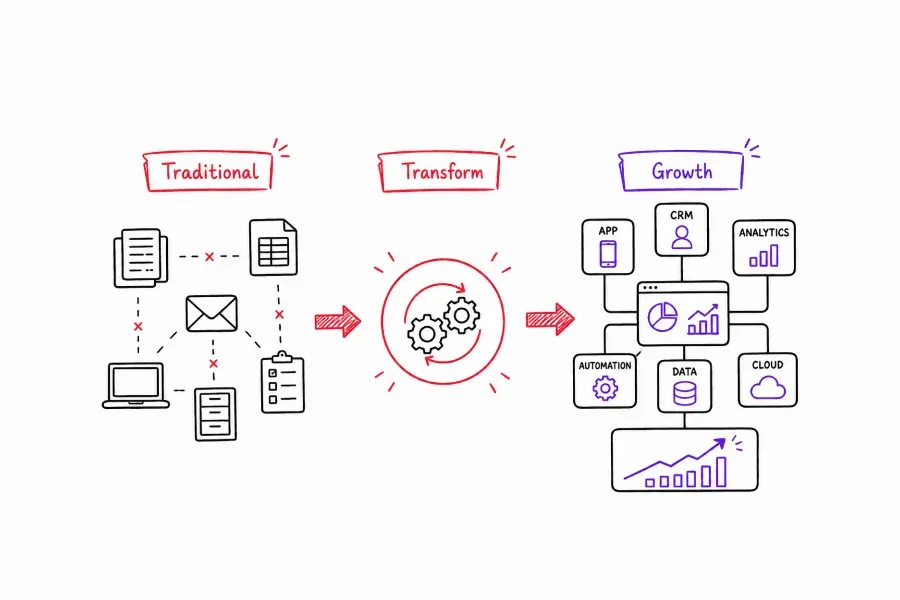
Digital transformation is the process of integrating digital technology across every function of your business. But more importantly, it's a fundamental shift in how your organization creates value. We're not talking about buying new software. We're talking about rethinking operations, culture, and strategy from the ground up.
For C-suite leaders in healthcare, manufacturing, retail, and financial services, this shift is no longer optional. According to McKinsey, companies that fully commit to digital transformation are 1.5 times more likely to achieve sustainable revenue growth than those that don't.
Yet, despite the clear business case, many organizations still struggle. Three core obstacles hold them back: cultural resistance to change, outdated legacy systems, and a critical shortage of skilled digital talent. We'll address all three and show you a smarter path forward.
1. Why Digital Transformation Is Essential for Business Growth Nowadays
Moving From Operational Efficiency to Strategic Growth
Here's the thing: digital transformation used to be about cutting costs. Today, it's about accelerating growth.
When your teams operate on modern, connected systems, they move faster. Decisions get made with real data, not gut feeling. New products reach the market in weeks, not quarters. That agility becomes a genuine competitive advantage.
Consider this: organizations with higher digital maturity consistently outperform their peers in revenue growth, customer satisfaction, and talent retention. According to Deloitte's Digital Transformation research, digitally mature companies are more profitable than their industry peers.
So, when we talk about why digital transformation is essential for business growth, we're really talking about the difference between leading your market and being left behind by it.
The Business Case for Transformation
The core digital transformation benefits across industries include:
- Faster revenue cycles through automation and digital service delivery.
- Improved customer experience through personalized, omnichannel engagement.
- Stronger operational efficiency that reduces costs and drives margin.
- Better leadership decisions powered by real-time data and AI-driven analytics.
- Greater organizational resilience during market disruptions.
Transformation is now a board-level priority, and rightly so. When your data, processes, and people are aligned digitally, your entire organization becomes more responsive, scalable, and profitable.
2. The Biggest Obstacles Holding Organizations Back
Cultural Resistance to Change
We'll say this clearly: technology rarely fails digital transformation. People do.
Cultural resistance is the single biggest reason transformation initiatives stall. Employees fear losing their roles. Middle managers resist losing control. Teams stick to legacy workflows because they feel safe and familiar. Without strong leadership alignment and honest communication, these tensions can quietly hinder even the most well-funded initiatives.
The solution? Agile transformation: building change adaptability into your organization's DNA. This means:
- Communicating the "why" behind transformation clearly and consistently.
- Involving frontline teams early, not just at rollout.
- Creating psychological safety for experimentation and iteration.
- Celebrating small wins to build momentum across functions.
As McKinsey notes, transformation programs that prioritize people and culture are four times more likely to succeed than those focused on technology alone.
Outdated Legacy Systems and IT Bottlenecks
If your core systems were built more than a decade ago, they're likely slowing you down in ways you may not fully see.
Legacy system modernization isn't just an IT conversation. It's a business survival conversation. Outdated infrastructure creates hidden costs, expensive maintenance, integration nightmares, security vulnerabilities, and limited scalability. Worse, it prevents your teams from adopting the tools that could genuinely accelerate growth.
IT modernization creates the technical foundation that everything else depends on: cloud-native platforms, API-driven integrations, real-time analytics, and scalable infrastructure that grows with your business. Without it, even the best digital strategy won't land.
The Talent Gap and Execution Challenges
There's a global shortage of professionals who can design, build, and manage modern digital environments. From AI engineers to cloud architects to change management specialists, demand far outpaces supply.
This is exactly where digital transformation consulting becomes a force multiplier. Rather than spending 18 months hiring and training the right team, experienced consultants like Intertec.io bring the expertise, frameworks, and cross-industry perspective that accelerate your results. They close capability gaps, reduce execution risk, and help you avoid the costly mistakes that less experienced teams make during digital transformation implementation.
3. Key Benefits of Digital Transformation Across Industries
Healthcare: Better Patient Experiences and Operational Efficiency
In healthcare, digital transformation directly impacts lives, not just ledgers.
When hospitals and health networks modernize their systems, they gain real-time access to patient data, reduce administrative burden, and improve care coordination across departments. Telehealth, AI-assisted diagnostics, and digital patient portals are shifting how providers deliver and how patients experience care.
Furthermore, compliance with regulations like HIPAA becomes far easier when your data infrastructure is modern, centralized, and auditable. The result? Better patient outcomes, lower operational costs, and stronger institutional trust.
Manufacturing: Smarter Operations and Faster Innovation
Manufacturing is experiencing a dramatic reinvention through digital transformation solutions like industrial IoT, AI-driven predictive maintenance, and smart automation.
Consider the impact: connected factory systems can detect equipment failure before it happens, reducing costly unplanned downtime. AI-enhanced demand forecasting improves inventory management and reduces waste. Digital twins allow manufacturers to simulate production changes before implementing them, saving time and capital.
According to PwC's Digital Factories 2020 report, manufacturers implementing digital technologies expect a 12% annual efficiency gain over the next five years.
Retail: More Personalized and Omnichannel Experiences
Retail has perhaps felt digital disruption most acutely. Customer expectations have risen sharply. Shoppers now expect seamless experiences across mobile, web, and in-store, and they'll quickly move to a competitor who delivers it.
Digital transformation enables retailers to leverage behavioral data, personalize recommendations, optimize inventory in real time, and create frictionless checkout experiences. Moreover, supply chain visibility reduces stockouts and improves fulfillment speed, both of which directly impact customer loyalty and revenue.
Financial Services: Agility, Security, and Customer Trust
For CFOs and CIOs in financial services, digital transformation carries both enormous opportunity and significant regulatory responsibility.
Modernizing core banking systems, payment infrastructure, and compliance workflows allows financial institutions to serve customers faster while managing risk more effectively. Artificial intelligence plays a key role here, from fraud detection and credit scoring to personalized financial advice and real-time reporting.
The payoff is clear: faster service delivery, stronger compliance posture, and deeper customer relationships built on transparency and trust.
4. What Drives Digital Transformation ROI
Linking Transformation to Measurable Outcomes
Digital transformation ROI isn't just about cost reduction. That's a common misconception we need to challenge directly.
True transformation ROI is measured across multiple dimensions:
| Metric | What to Measure |
| Productivity | Output per employee, process cycle time |
| Revenue Growth | New digital revenue streams, customer acquisition |
| Customer Retention | NPS scores, churn rate, lifetime value |
| Speed to Market | Product launch timelines, feature delivery velocity |
| Risk Reduction | Compliance incidents, cybersecurity events |
| Cost Efficiency | Infrastructure costs, manual process elimination |
The key is defining your success metrics before transformation begins. Without clear KPIs tied to business goals, it becomes nearly impossible to demonstrate value to stakeholders or course-correct when things drift off track.
The Most Important Digital Transformation Success Factors
After working across industries, we've seen that the following digital transformation success factors consistently separate leaders from laggards:
- Executive sponsorship with a clear vision: Transformation needs a visible champion at the top, not just a delegated project team.
- Cross-functional collaboration: Silos kill transformation. Break them early and often.
- Scalable technology choices: Build on platforms that grow with you, not ones that create new constraints.
- Employee adoption and change management: Technology is only as good as the people using it.
- A phased implementation approach: Quick wins build momentum. Avoid attempting all changes simultaneously.
As Gartner research consistently highlights, organizations that follow a structured, phased approach to digital initiatives are significantly more likely to achieve their intended outcomes than those that attempt large-scale, big-bang transformations.
5. How to Approach Digital Transformation Implementation
Start With Business Priorities, Not Just Technology
This is where many organizations go wrong. They buy a new platform, deploy it widely, and then ask, "Now what?"
Instead, start with the business problem. Ask yourself:
- Where are we losing the most time, money, or competitive ground today?
- Which customer experiences are failing to meet expectations?
- What decisions would we make differently with better data?
Then, and only then align your digital transformation implementation to those specific answers.
Build a Roadmap That Matches Your Digital Maturity
Not every organization starts in the same place. That's completely fine. What matters is knowing where you are and building a roadmap that's realistic for your current capabilities.
A solid roadmap includes:
- Current-state assessment. What systems, processes, and capabilities do you have today?
- Gap analysis. Where are the critical differences between where you are and where you need to be?
- Quick wins. What can you achieve in 90 days to demonstrate value and build organizational confidence?
- Long-term modernization priorities. Which legacy systems need replacing, and in what sequence?
This phased approach is especially important in regulated industries like healthcare, financial services, and government, where risk management and compliance cannot be sacrificed for speed.
Use AI and Modernization as Growth Enablers
Artificial intelligence is no longer a futuristic concept. It's a practical growth tool available to businesses of every size.
From automating repetitive workflows to delivering personalized customer experiences at scale, AI creates leverage across your entire organization. But AI works best on a modern data infrastructure. Without clean, connected, accessible data, even the most sophisticated AI tools underperform.
That's why modernization isn't just a technical milestone. It's a prerequisite for AI-driven growth. When your infrastructure is modernized, AI becomes a genuine competitive advantage, not just an expensive experiment.
Furthermore, transformation should never be treated as a one-time project. The best-performing organizations treat digital evolution as a continuous discipline. Markets shift. Technology advances. Customer expectations rise. Your transformation program must stay agile enough to evolve alongside them.
6. When to Bring in Digital Transformation Consulting
Getting Expert Support to Reduce Risk
There's real wisdom in knowing when to ask for help. Digital transformation is complex, multi-layered, and often politically charged within organizations. Bringing in experienced digital transformation consulting partners can significantly reduce both risk and time-to-value.
Here's specifically where consultants add the most value:
- Strategy and roadmap development: Experienced consultants have seen what works across dozens of industries and organizations. They help you avoid the costly detours.
- Change management: Navigating internal resistance requires expertise that goes beyond project management. Consultants bring structured frameworks for adoption and communication.
- Technology selection: With so many platforms and vendors competing for your attention, independent guidance is invaluable. Consultants help you choose based on your needs, not vendor marketing.
- Implementation oversight: Keeping complex, multi-workstream programs on track requires dedicated governance and accountability.
This kind of expert support is especially valuable in heavily regulated industries (healthcare, financial services, and government) where getting transformation wrong has serious legal and operational consequences.
Conclusion: Digital Transformation Is a Growth Strategy, Not Just a Tech Initiative
Let's bring it back to the core question: why is digital transformation essential for business growth?
Because the alternative is stagnation. Because your competitors are not waiting. Because customers now expect digital-first experiences, and the organizations that deliver them are capturing more market share every quarter.
The risks of delay are real and compounding. Every year spent on legacy infrastructure is another year of hidden costs, missed opportunities, and widening capability gaps. Meanwhile, the organizations that move with intention are building competitive moats that will be very difficult to overcome.
Digital transformation isn't a single project with a finish line. It's a journey, and the most successful leaders approach it as such with clear priorities, a phased roadmap, and the courage to challenge the status quo.
We know this journey can feel overwhelming. But it doesn't have to be. Whether you're just beginning to assess your digital maturity or you're mid-transformation and encountering friction, the right guidance makes all the difference.
We'd love to hear where you are in your digital transformation journey. Let's talk about your challenges, your goals, and how we can help you build a roadmap that actually works.